
Want Your Kids to Open Up? Go First
Me: How was school?
Kiddo: Fine.
Me: What did you do?
Kiddo: Nothing.
Me: Anything interesting happen?
Kiddo: Nope.
If you have kids, you know this conversation. It's like pulling teeth. You want to know what made them laugh, what bothered them, what they learned, who they sat with. Instead you get "fine" and a shrug, and then they disappear into their room while you're left wondering what actually happened in their world today.
We've all heard the standard advice. Ask better questions. Don't ask anything they can answer with yes, no, or good. Ask something specific. "What was the funniest thing that happened today?" gets you further than "how was school." And honestly, that advice works. I use it. I'm not knocking it.
But I found something else that works, and nobody really talks about it.
You Go first…!
Instead of opening with a question, I started opening with my own day. I sit down and just start sharing. Something that happened at work. Something that frustrated me. Something funny. Something I accomplished, or something I screwed up. Nothing dramatic. Just real.
Then I turn it over.
"I had this meeting today that I thought was going to be really rough, but it actually went pretty well. What about you? You had math today, right? What did you guys work on?"
And something shifts. It's not an interrogation anymore. It's a conversation. They just watched me walk through my day, so when I ask about theirs, they have a map. What did you go over? Was it hard? Was it boring? Did anybody say anything funny? They're not starting from a blank page. I broke the ice, and now it's broken for both of us.
One thing worth saying here. There's a difference between sharing your life with your kids and making your kids responsible for your problems. I'm not dumping my stress on them or handing them things they're not built to carry. I'm just letting them know Dad has a life too. Things happen to me. I get excited, I get frustrated, I learn things, I mess things up. I have stories. And then I give them room to tell theirs.
Here's the part that matters more than getting a better answer at the dinner table.
Knowing how to have a conversation is a skill. We expect our kids to tell us about their day, explain what happened, describe how they felt, ask a question, listen, respond, keep things moving. But where are they supposed to learn that? From us. And I really believe a lot of kids today are losing that ability. They can text, they can scroll, they can react. But holding an actual conversation, telling a story about their own day? That gets learned by watching someone do it.
Words are how we express ourselves. How we communicate, how we get our point across, how we negotiate, how we disagree, how we ask for something, how we stand up for ourselves, how we let people know what's going on in our lives. All of it comes down to the words we choose and the words we use. That's true for our kids, and honestly, it's true for us. There are plenty of adults walking around who never learned how to say what they mean or tell their own story. We've all met them. Some days we've been them.
Our kids aren't going to magically become great communicators at 18. They learn by communicating. With us.
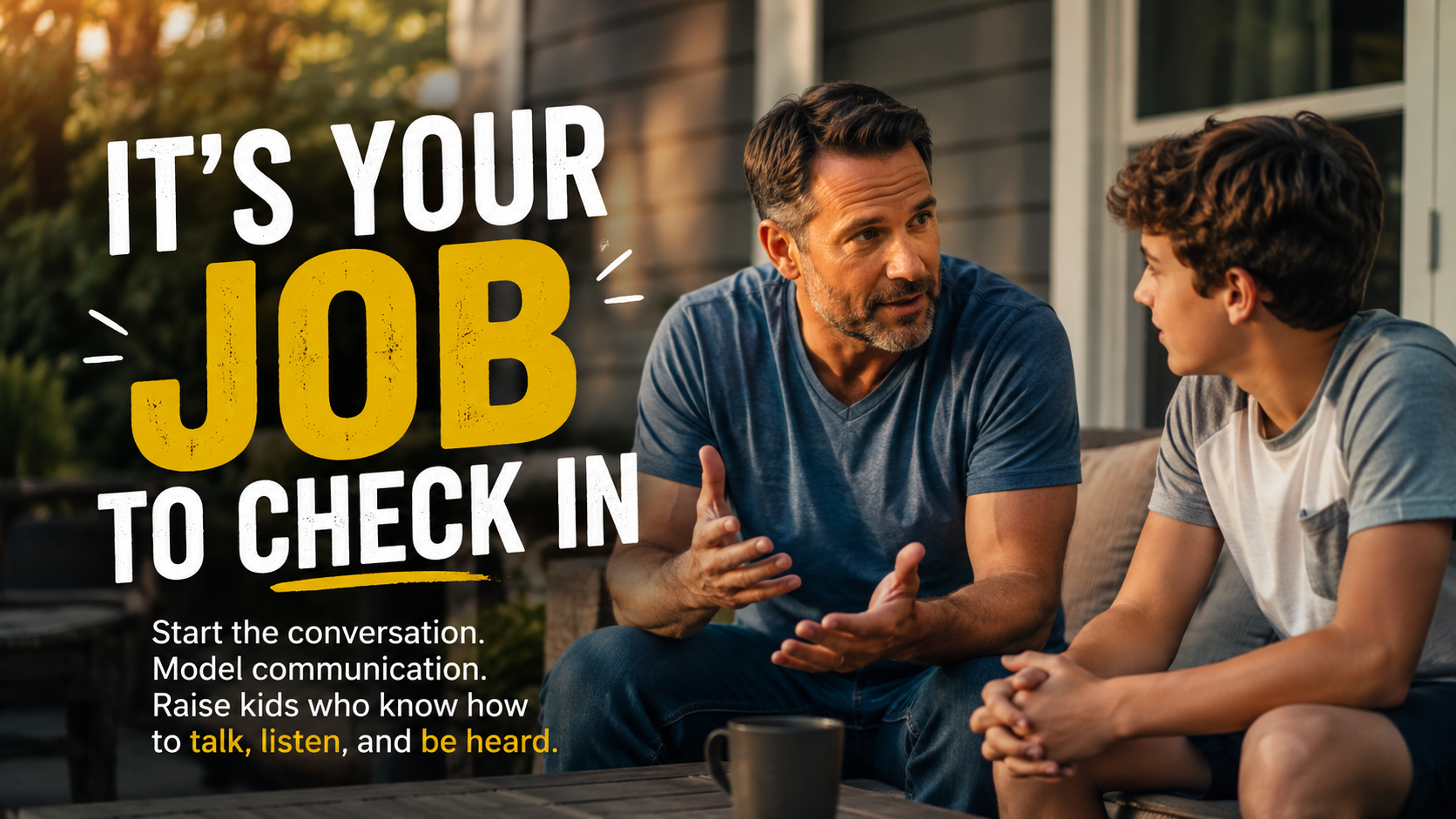
Which brings me to the real point. It's your job to check in. Not theirs. We spend a lot of energy wishing our kids would come to us, open up to us, keep us in the loop. But kids can smell a one-way street. If all we ever do is ask, ask, ask, and never offer anything of ourselves, why would they hand over the good stuff?
So here's the takeaway, and you can use it tonight.
Before you ask about their day, tell them about yours. Two minutes. Something real. Then ask, "What about you?"
You might still get "fine" the first time. Or the fifth time. That's okay. You're not running a script, you're building a habit, and habits take reps. But every time you go first, you're showing them what a conversation looks like. You're showing them that in this family, we share. Both directions.
And you're teaching them something bigger than how to recap a school day. You're teaching them how to talk, how to listen, how to tell their story. And you're proving, one check-in at a time, that when they have something worth talking about, you're someone they can talk to.
That's the work. It starts with us.
